 |
| responsibletechnology.org |
by Barbara Upton
Never in human history have we taken the DNA from one species and artificially forced it into the DNA of a different species. Arctic fish genes have been forced into tomatoes, jellyfish genes have made pigs' noses glow in the dark and cow genes have turned pigskin into cowhide. But the real danger lurks in the eight GM foods on the market in the US today: corn, soy, cotton, canola oil, sugar beets, zucchini, crookneck squash and Hawaiian papaya. The more we learn about the unpredictability of this infant, radical technology, the government collusion with the biotech industry and the fraudulent, industry-funded "science" behind GM crops, the more we realize we must go the way of most of Europe, Japan, South Korea, Australia, New Zealand and other countries and demand to know what we are eating and feeding our families. We must begin by insisting that all foods with GMOs (genetically modified organisms) be labeled so we can avoid them. Here are ten reasons why.
1. GM foods are not safe! The American Academy of Environmental Medicine (AAEM) says GM foods "pose serious health risks". Nineteen GM animal feeding studies show damage to the immune system, infertility, organ damage, insulin deregulation, increased mortality, accelerated aging, and potential precancerous cell growth. In one study, 50% of baby rats born of mothers fed a GM diet, were dead in three weeks (five times higher than normal). The babies who survived were much smaller and preliminary evidence indicated they were not able to conceive.
AAEM calls for an immediate moratorium on GMOs and recommends that doctors prescribe a non GMO diet for all their patients. In the only human feeding study (yes, there has only been one) GMOs survived and continued to function in the stomachs of people who had eaten GM food. No follow-up studies were done.
Never in human history have we taken the DNA from one species and artificially forced it into the DNA of a different species. Arctic fish genes have been forced into tomatoes, jellyfish genes have made pigs' noses glow in the dark and cow genes have turned pigskin into cowhide. But the real danger lurks in the eight GM foods on the market in the US today: corn, soy, cotton, canola oil, sugar beets, zucchini, crookneck squash and Hawaiian papaya. The more we learn about the unpredictability of this infant, radical technology, the government collusion with the biotech industry and the fraudulent, industry-funded "science" behind GM crops, the more we realize we must go the way of most of Europe, Japan, South Korea, Australia, New Zealand and other countries and demand to know what we are eating and feeding our families. We must begin by insisting that all foods with GMOs (genetically modified organisms) be labeled so we can avoid them. Here are ten reasons why.
AAEM calls for an immediate moratorium on GMOs and recommends that doctors prescribe a non GMO diet for all their patients. In the only human feeding study (yes, there has only been one) GMOs survived and continued to function in the stomachs of people who had eaten GM food. No follow-up studies were done.
2. The FDA approved GM crops despite protests of the agency's own scientists. An overwhelming consensus of FDA scientists warned that GM foods could create allergens, toxins, nutritional problems and even "new diseases". However; the first Bush administration was intent on promoting GMOs so they appointed a former Monsanto lawyer, Michael Taylor, who developed the policy on GM foods, saying they were no different from conventional varieties. The policy was called "a political document" and "very pro-industry" by a microbiologist at the FDA. It was not based on peer-reviewed science. Taylor went on to become vice-president of Monsanto and is now back in government as our food safety czar! If a biotechnology company declares a GM crop is safe, that is good enough for the FDA.
3. GM crops are contaminating our entire food supply. At a conference in 1999, Monsanto said their goal was to ensure that 100% of seeds were genetically modified and patented (by them, of course) in 15 to 20 years. One way to achieve this is to contaminate naturally growing crops.
One Monsanto executive put it this way,“The hope of the industry is that over time, the market is so flooded that there’s nothing you can do about it. You just sort of surrender.”
Once contamination occurs there is virtually no way to recall it. In a 2004 government study, GM bentgrass cross pollinated with natural bentgrass 13 miles downwind. The industry thought the pollen could only travel 1000'! The Forest Service says this one example "has the potential to adversely impact all 175 national forests and grasslands." A 2010 study showed that 80% of wild canola in North Dakota had been contaminated with GM genes.
Even more worrisome, the USDA has even approved hundreds of open-air field trials of pharmaceutical crops- crops genetically engineered to produce drugs, like blood thinners, vaccines and powerful growth hormones, as well as industrial enzymes. In 2002, corn genetically engineered to produce a pig vaccine contaminated a half million bushels of soybeans.
Even more worrisome, the USDA has even approved hundreds of open-air field trials of pharmaceutical crops- crops genetically engineered to produce drugs, like blood thinners, vaccines and powerful growth hormones, as well as industrial enzymes. In 2002, corn genetically engineered to produce a pig vaccine contaminated a half million bushels of soybeans.
In addition to contamination, Monsanto has spent billions buying up conventional seed companies toward their goal of a world in which natural seeds are virtually extinct. Monsanto provides 90% of GM seed sown globally.
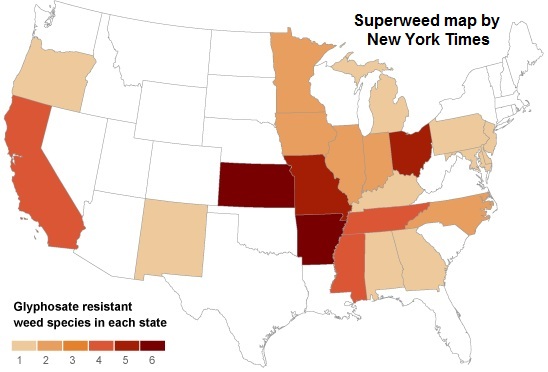 |
| NY Times May 2010 |
 |
| Wheat after Ten Years of Glyphosate Use Jeffrey Smith |
Besides rendering soils infertile, decreasing nutrients in plants and contributing to 40 plant diseases where it is used, glyphosate is also linked to sterility, hormone disruption, miscarriages, birth defects and cancer. From farms to lawns, our country is drenched in it.
5. GM crops do not increase yields. In 2009, the Union of Concerned Scientists debunked Monsanto's claim that GM crops would increase yields. “Traditional breeding outperforms genetic engineering hands down.” states the report. This was further corroborated by a UN/World Bank report of 400 scientists in 58 countries that concluded that organic farming is the only sustainable way forward. In ten years, many African countries doubled yield using organic practices.
5. GM crops do not increase yields. In 2009, the Union of Concerned Scientists debunked Monsanto's claim that GM crops would increase yields. “Traditional breeding outperforms genetic engineering hands down.” states the report. This was further corroborated by a UN/World Bank report of 400 scientists in 58 countries that concluded that organic farming is the only sustainable way forward. In ten years, many African countries doubled yield using organic practices.
6. The biotechnology industry hurts small farmers. You may have heard of Monsanto's "Seed Police" spying on and harassing farmers across America's heartland. When farmers buy the more expensive GM seeds they are prohibited from using them the next year. If GM seeds find their way onto farms, through contamination by wind or insect pollination, the farmer is sued by Monsanto. As a North Dakota farmer said, "Farmers are being sued for having GMOs on their property that they did not buy, do not want, will not use and cannot sell." Monsanto also encourages farmers to turn one another in and they have been brutal in their dealings with small farmers, suing hundreds and going after their homes and farms.
Additionally, farmers of GM crops have lost money due to a decrease in export sales because of lack of trust in GM crops by other countries. Monsanto wanted to create GM wheat, but wheat farmers fought them fearing loss of markets (US corn lost 99.4% of the European corn market after being genetically modified).
Additionally, farmers of GM crops have lost money due to a decrease in export sales because of lack of trust in GM crops by other countries. Monsanto wanted to create GM wheat, but wheat farmers fought them fearing loss of markets (US corn lost 99.4% of the European corn market after being genetically modified).
7. The biotechnology industry uses bad science to justify their claims. Monsanto once did a study to ally farmers' fears that their genetically modified bovine growth hormone (rBGH) caused increased infertility in cows. Monsanto secretly added cows already pregnant to the study to show there was no decrease in fertility! Monsanto also declared rBGH dairy safe for humans, although it dramatically increases the level of the hormone IGF-1 which is the number one risk factor for breast cancer and is linked to prostate and colon cancer. The company rigged the testing (pasteurizing milk 120 times longer than normal) to claim rBGH is destroyed by pasteurization.
Monsanto falsified research studies to hide the cancer causing nature of dioxin in its Agent Orange and a former manager of Monsanto India said Monsanto "faked scientific data" given to government regulators to get their GM products approved. In 2005, a German court ordered Monsanto to make a study public that they had been suppressing that showed changes in blood, livers and kidneys of rats given GM food. And there are myriad ways biotech researchers have been known to rig their studies.* Are these the guys you want to trust with the food you eat?
Monsanto falsified research studies to hide the cancer causing nature of dioxin in its Agent Orange and a former manager of Monsanto India said Monsanto "faked scientific data" given to government regulators to get their GM products approved. In 2005, a German court ordered Monsanto to make a study public that they had been suppressing that showed changes in blood, livers and kidneys of rats given GM food. And there are myriad ways biotech researchers have been known to rig their studies.* Are these the guys you want to trust with the food you eat?
 |
| from the Institute for Responsible Technology |
8. Many animals avoid GM foods when given a choice.What do they know that we don't? One farmer decided to try an experiment with a bag of GM corn and regular corn. He put both bags in his woodshed to conduct the experiment in the winter. But later he found the mice had done the experiment for him. All the conventional corn was eaten, the GM corn had not been touched! Cows, elk, geese, pigs, buffalo, raccoons, squirrels, rats, mice and other animals all try to avoid eating GM food!
9. Since GM foods have been introduced into the American diet, there have been increases in chronic diseases and allergies. We don't know exactly what is tied to GM food consumption, because so few studies are done, but consider this: since the mid 1990s when GM foods were introduced in the US, the number of Americans with three or more chronic diseases doubled from 1994 to 2001, food-related illnesses in the US also doubled from 1997 to 2002, as did trips to the ER for allergic reactions. There has also been a surge in obesity, autism, Alzheimer's, ADD, gastrointestinal problems, certain cancers and more.
 |
| From responsibletechnology.org's Power Point |
We do know that a genetically modified supplement,called L-Tryptophan killed 100 and permanently disabled and sickened thousands of Americans in the 1980s. It created acute symptoms that came on quickly which helped researchers trace the illness. So what if GM foods today are creating proliferative cell growth in our stomach lining as as they do in rats, and what if that turns cancerous in ten or twenty years? How long would it be before links to a GM diet could be made? And if links are found, how do you recall millions of acres of GM crops?
10. We are all guinea pigs in this unprecedented, unregulated GM experiment. The biotech industry would have you believe that inserting genes from bacteria, or viruses into the DNA of a corn or soy plant is a neat, orderly and safe process, like inserting a new page into a book. What they do not tell you is the process of genetic modification itself causes massive collateral damage to the finely controlled, intricate web of DNA. The transgenes are shot into DNA with a 22 caliber gene gun. Where they are inserted can cause hundreds or thousands of mutations throughout the genome, can destroy natural genes, permanently turn genes on or off and create unpredictable and potentially dangerous side effects. As Dr Suzanne Wuerthele, a toxicologist with the EPA said, “We are confronted with the most powerful technology the world has ever known, and it is being rapidly deployed with almost no thought whatsoever to its consequences.”
Sign the petition for labeling GM foods. Write and call your elected representatives, write letters to the editor, share information, talk this up and join a local nonGMO group (and if there isn't one- form one!). Stay tuned for an article on how we can begin by avoiding GM foods so we can reach a tipping point of consumer rejection to demand labeling. If Europe can do it, so can we!
"Just sort of surrendering" to the genetic modification of our food supply is not an option.
"Just sort of surrendering" to the genetic modification of our food supply is not an option.
________________________________
*Industry researchers are paid to not find problems with GM foods and most of the research on GM is industry-funded. In fact, Monsanto blocks independent researchers from using its patented GM seeds for study.
Here are just a few of the tricks the company researchers use.
- Use highly variable animal starting weights to hinder detection of food-related changes
- Keep feeding studies short to miss long-term impacts
- Test effects of roundup ready soybeans that have not been sprayed with roundup
- Avoid feeding animals the actual gm crop, but give them instead a single dose of the gm protein that was produced inside gm bacteria
- Use too few subjects to derive statistically significant results
- Use poor statistical methods or simply leave out essential methods, data, or statistics
- Use rigged or irrelevant control groups, and
- Employ insensitive or obsolete evaluation techniques
from "Company Research on Genetically Modified Foods is Rigged" by Jeffrey Smith, executive director of the Institute for Responsible Technology. I was recently trained by Jeffrey in an online webinar and thank him for his pioneering work on the health dangers of GM foods!
and thanks to Ellen Naney of Women in Black for her phrase- "GMO? OMG!" I see bumper stickers!


